Teaching morphology: prefixes, suffixes, and roots (Grades 4–8)
By fourth grade, the vocabulary gap stops being about how many words a student has memorized and starts being about whether they can take an unfamiliar word apart.
Somewhere around fourth grade, the texts change. The words get longer, more abstract, and more Latin. "Big" becomes "significant," "tell apart" becomes "distinguish," and a student who reads fine in third grade suddenly stalls — not on decoding, but on meaning. They can say the word. They just have no idea what it means, and no strategy for figuring it out.
You can't teach your way out of that gap one word at a time. English has too many words. What you can teach is how words are built — and morphology (prefixes, suffixes, and roots) is the strategy that lets a student unlock words nobody ever taught them.
Why morphology beats memorizing definitions
Roughly 60% of the academic words students meet in upper-elementary and middle school are morphologically transparent — you can figure out the meaning from the parts. A student who knows port means "carry" has a foothold on transport, import, export, portable, and porter. That's five words from one root, plus a strategy for the sixth word they haven't met yet.
Compare that to a vocabulary list of twenty definitions to memorize by Friday. The list is gone by Monday. The root sticks, because it keeps paying off in every text.
Teach the parts that carry the most weight
Start with high-frequency prefixes and suffixes. A handful of affixes — un-, re-, dis-, in-/im-, -tion, -able, -ment — appear in a huge share of academic words. Teaching these first gives the fastest return.
Then move to Greek and Latin roots. This is where the content-area words live: photo, graph, bio, geo, spect, dict, struct. Science and social studies vocabulary is built almost entirely from them.
Teach the taking-apart habit explicitly. Model it out loud: cover the affixes, find the root, ask "what does this part mean?", then reassemble. "Unbelievable — un (not) + believe + able (can be) — a thing that can't be believed." Do it enough and students start doing it automatically.
Vocabulary you memorize covers the words on this week's list. Morphology covers every word a student will ever meet — including the ones no teacher had time to pre-teach.
Make it stick with short, spiraling practice
Morphology rewards frequency over intensity. A few minutes several times a week — one root, a handful of words built from it, and a quick "predict the meaning of a new word" — beats a once-a-unit deep dive. Spiral back to old roots constantly so they don't fade.
And connect it to real reading. The payoff a student feels is decoding the meaning of a hard word in the actual text they're reading, on their own. That moment — "oh, inaudible means you can't hear it" — is what turns a strategy into a habit.
A ready-made morphology sequence
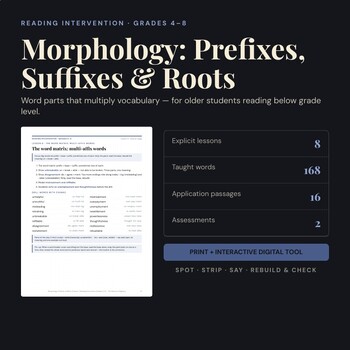
I built our Morphology pack for Grades 4–8 around this exact approach — high-frequency affixes first, then Greek and Latin roots, with explicit take-it-apart practice and words pulled from real academic and content-area vocabulary. It's built to work as a warm-up or a reading-intervention block, so it fits the time you actually have.
If you want to see where your students land before you plan a sequence, there's a free morphology assessment plus a sample week — give the assessment, see which affixes and roots are missing, then decide where to start. It sits alongside our structured phonics & decoding library, the next step once decoding is solid.
The bottom line
The vocabulary gap in the upper grades isn't a memory problem — it's a strategy problem. Teach students how words are built, drill the taking-apart habit until it's automatic, and you hand them a tool that works on every hard word they'll ever meet, long after they've left your class.