Teaching the human body systems: a no-prep interactive lesson (K–5)
Kids don't struggle with the body because it's complicated. They struggle because it's usually taught as eleven disconnected worksheets instead of one system that works together.
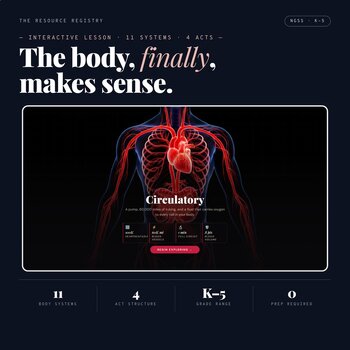
Ask a class what the heart does and you'll get "it pumps blood." Ask why, and the room goes quiet. That gap is the whole challenge of teaching the human body in elementary school: kids can name the parts long before they understand how the parts keep them alive. And the body doesn't cooperate with the usual approach — you can't really understand the lungs without the blood, or the blood without the heart, or the heart without the muscles that move everything.
Taught as eleven separate worksheet packets, body systems become vocabulary to memorize and forget. Taught as one connected story, they become something kids can reason about. Here's how to make that shift — even if science isn't your strong subject.
Start with the job, not the label
Every system has a job. Lead with the job and the parts fall into place. The respiratory system's job is to get oxygen in and carbon dioxide out — so of course it needs lungs, and of course it has to hand that oxygen to the blood. When a five-year-old understands "your body needs oxygen and this is how it gets it," the word "respiratory" sticks because it's attached to a reason.
This is also how you differentiate without rewriting the lesson. Kindergarteners learn the job and one or two parts. Fifth graders learn the job, the parts, and how the system trades with two others. Same content, different depth.
Make the connections visible
The single most important move is showing how systems hand off to each other. Oxygen comes in through the respiratory system, rides the circulatory system, and gets burned by the muscular system to move you. That hand-off is the concept. When kids can trace one breath through three systems, they've understood something a labeling worksheet can't teach.
The body isn't eleven topics. It's one machine with eleven jobs. Teach the hand-offs and students stop memorizing parts and start explaining how they stay alive.
Let kids explore, then pin it down on paper
Young learners understand systems best when they can poke at them — reveal a part, predict what it does, check if they were right — and then consolidate that thinking with writing or drawing. Interactive first, worksheet second. The screen builds the mental model; the paper makes it stick and gives you something to assess.
For grades 3–5, add a "make a claim and back it with evidence" step. "The circulatory system depends on the respiratory system because…" is a sentence that turns a science fact into science thinking — exactly the reasoning next-generation standards ask for.
The no-prep version
I built our Human Body Systems interactive lesson to teach exactly this way. It covers all 11 systems in one consistent four-act structure — a mystery clue and a guess, the system's real job, an interactive explore-and-reveal, and (for grades 3–5) a deeper claim-evidence-reasoning activity — plus differentiated worksheets for every grade. It runs in any browser and projects on any whiteboard. No login, no install, no setup.
If you want to see how the four acts feel before buying the full unit, there's a free Skeletal System sample — the complete skeletal lesson, fully interactive, at no cost. Teach one system, see if your class responds, then decide.
The bottom line
The human body is the rare science topic where kids are already fascinated — it's theirs. Don't bury that curiosity under vocabulary lists. Teach each system's job, show how the systems trade with each other, and let students explore before they write. That's how "the heart pumps blood" turns into a child who can explain why they're still breathing.