Teaching email etiquette and digital citizenship (Grades 5–8)
Every middle schooler can send a message in three seconds. Almost none of them can write an email a teacher, coach, or future boss takes seriously. That gap is teachable.
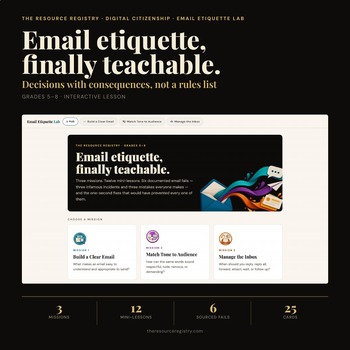
Here's a scene every middle-school teacher recognizes. A student emails you: no subject line, no greeting, lowercase, "hey did we have homework." They're not being rude — they genuinely don't know there's another way. They grew up fluent in group chats and comment threads, and nobody ever taught them that a different context has different rules.
We assume "digital natives" understand the internet. They understand using it. Acting well on it — writing a message someone respects, thinking before posting, knowing what a digital footprint is — is a separate skill, and it's one adults have to actually teach.
Fluent with a phone is not the same as competent online. Kids can operate every app on earth and still have no idea that the internet remembers, or that an email is a first impression.
Start with the one they'll use this year: email
Email is the perfect entry point because the payoff is immediate and concrete. Students email teachers, coaches, and — soon — the people who decide things about their lives. A message that opens with a greeting, states its purpose, and signs off gets a different response than "hey did we have homework." Teach the anatomy explicitly: subject line, greeting, the ask, a thank-you, a sign-off. Then have them rewrite a real bad email into a good one. They feel the difference instantly.
Then make the invisible visible: the digital footprint
The abstract idea that "the internet is forever" doesn't land as a warning. It lands as a demonstration. Walk students through how a post, a comment, or a photo persists — screenshotted, searchable, resurfaced years later by someone they haven't met yet. The goal isn't fear; it's a mental habit: would I be fine with this being findable in five years? That single question does more than any list of rules.
Keep internet safety concrete, not scary
Safety lessons fail when they're a lecture. They work when they're scenarios. What do you do when a stranger DMs you? When a "free" offer wants your info? When a friend shares something that isn't theirs to share? Give students realistic situations and let them reason through the move. You're building judgment they can use at 9 p.m. on a Saturday when you're nowhere near — which is exactly when they'll need it.
What we built for this
I built a set of ready-to-teach lessons for Grades 5–8 that cover exactly these: email etiquette, and a broader digital citizenship unit covering digital footprint, internet safety, and online behavior — with a bundle if you want both. They're scenario-driven and no-prep, built for a real middle-school class, not a lecture.
Try one first: there's a free "how to write an email" lesson and a free internet-safety lesson. Run one and watch how quickly students realize nobody ever actually taught them this.
The bottom line
Middle schoolers don't need to be scared off the internet — they live there, and they will keep living there. They need to be taught how to act well in it: write the respectful email, think before the post, reason through the risky moment. Teach it explicitly, use real scenarios, and you hand them judgment that pays off long after they leave your room.