When older students still can't decode long words (Grades 4–8)
A seventh grader who reads short words fine but guesses at 'representative' doesn't have a comprehension problem. They have a decoding problem nobody caught.
There's a particular struggling reader who slips through every net. They read short, familiar words with no trouble, so they don't look like a decoding case. But hand them unfortunately or representative or civilization and they stall, guess from the first syllable, or skip the word entirely. By the time they're in fourth grade and up, almost every important word in a text is long — so this quiet gap quietly wrecks their comprehension.
The fix is real phonics instruction, aimed at long words. The problem is that most phonics materials are built for six-year-olds, and nothing shuts down a twelve-year-old faster than a worksheet with a cartoon cat. Teaching multisyllabic decoding to older students is a specific job: the skill of a beginner, the respect of an adult.
Why long words break older readers
Short words can be memorized as wholes; long words can't. A reader who's been getting by on whole-word memory and context guessing runs out of road the moment the vocabulary turns multisyllabic and abstract. They were never taught a reliable way to break a long word into chunks and put it back together — so they improvise, and improvising fails.
Crucially, this usually isn't a comprehension weakness. These students often understand a text fine when it's read to them. The bottleneck is getting the words off the page. That's good news: decoding is teachable, fast, at any age.
Teach a syllable strategy, not more sight words
Give them a way in. Older strugglers need an explicit routine for attacking a long word — spot the vowels, break between them, decode each chunk, blend, and adjust until it sounds like a real word. A repeatable procedure beats "sound it out," which they've heard a thousand times and still can't do.
Teach the six syllable types and common patterns. Knowing whether a syllable is closed, open, or vowel-team tells a reader which vowel sound to try. That's the difference between decoding reptile and guessing at it.
Use real, grade-worthy words. Practice on the academic and content-area vocabulary they actually meet — not cat and mat. The words should feel like their world.
A middle schooler who can't read "representative" isn't lazy and isn't unintelligent. They were handed long words without ever being taught how long words come apart. That's a fixable gap — and fixing it is fast.
Protect their dignity
This is the part that makes or breaks older-student intervention. The materials have to look their age. A struggling seventh grader is often deeply embarrassed about reading, and the fastest way to lose them is to hand them something that looks like it's for their little sibling. Grown-up design, real content, and — where possible — audio support so they can self-correct without raising a hand and outing themselves.
The tools we built for this
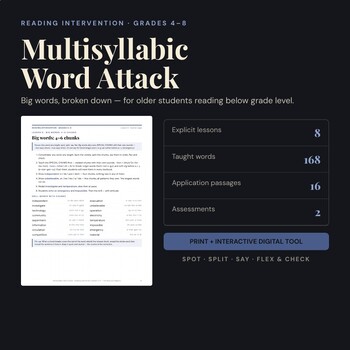
I built our multisyllabic decoding pack and syllable-types pack for exactly this reader — explicit strategies, real grade-level words, audio support, and a design that respects a Grade 4–8 student. There's a bundle if you need the full decoding sequence.
Not sure who actually needs it? Start with the free decoding diagnostic — it shows you which students read fine until the words get long, so you're not guessing about who to pull. It's part of our full structured phonics & decoding library, from K–2 decodables up through older-student decoding.
The bottom line
The student who reads short words fine and freezes on long ones isn't a lost cause and isn't a comprehension case — they're a decoding case nobody flagged. Teach an explicit strategy for taking long words apart, use words worthy of their grade, and keep the materials age-appropriate. Decoding is teachable at any age. The only real mistake is deciding it's too late.