Low-prep STEM stations that actually work in a K–5 classroom
Most STEM centers die for one reason: they take longer to prep than they take to run. The fix isn't more materials — it's stations kids can start without you.
Every teacher has tried the beautiful STEM center. You saw it online, spent a Sunday gathering popsicle sticks and pipe cleaners, laminated the task cards — and by Wednesday it was a bin of tangled supplies nobody touched. The problem usually isn't the kids and it isn't you. It's that the station took forty minutes to build and fell apart the moment three seven-year-olds needed you at once.
Low-prep STEM stations solve a different problem than "fun." They solve independence. A station only works if a group can read the card, know what to do, and get moving while you're across the room with another group. Here's how to build that.
What makes a station low-prep (and self-running)
One clear task, one page. If a child has to flip between three sheets to understand the activity, it's not a station — it's a lesson that needs you. The best stations state the challenge, the materials, and the "you're done when…" in a single glance.
Materials you already own. Paper, tape, cups, blocks, crayons. The moment a station needs a class set of something special, it becomes a once-a-year event instead of a Tuesday. Reusable beats elaborate.
A built-in check. Kids need to know when they've succeeded without asking you. "Your tower has to hold the book for ten seconds" is self-checking. "Build a good tower" is not.
The rotation that keeps it calm
Four to six stations, small groups, a timer. Students rotate on a fixed signal so nobody's waiting on you to move. The magic number is stations that run eight to twelve minutes — long enough to think, short enough that a stuck group isn't stuck for the whole block.
Mix the types so the room self-regulates: one build challenge, one sorting or pattern task, one drawing-and-labeling station, one "quiet think" station. If every station is a loud build, the room hits eleven on the volume dial and stays there.
A good STEM rotation isn't measured by how impressive it looks. It's measured by whether you can kneel next to one group for five minutes without the other twenty kids falling apart.
Make it work across K–5
The same challenge can flex across grades if you change the constraint, not the whole activity. "Build the tallest tower" becomes, for older students, "build the tallest tower that holds a weight and uses no more than twenty pieces." Same materials, same setup, harder thinking. That's how a multi-grade building or a mixed group runs one rotation instead of five.
For the youngest kids, lean on sorting, patterning, and observe-and-draw tasks — real STEM thinking that doesn't require reading a paragraph of directions. For grades 3–5, add a planning step and a "what would you change?" reflection so the engineering-design habit shows up.
Where our STEM Stations fit
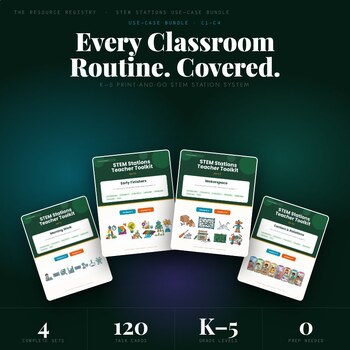
I built our STEM Stations around exactly these rules: one-page, print-and-go cards; materials you already have; a clear "done when" on every task; and constraints that flex from K to 5. There are seasonal sets, subject sets, and use-case sets (morning work, makerspace, centers) so you can drop them into whatever slot your schedule actually has.
If you want to see whether the format fits your room before buying anything, grab a free set first — there's a free Animals & Habitats set and a free Morning Work / Soft Start set. Run one rotation, see if your class can actually work it independently, then decide.
The bottom line
STEM centers don't fail because kids don't like them. They fail because they demand the one thing you don't have during centers — you. Build stations a group can start, run, and finish on their own, and STEM stops being a Sunday-night project and starts being a part of your week.