Ghost stories for close reading: passages Grades 4–8 will finish
A ghost story gets students to read every word. Then asking 'but is it true?' turns that attention into the most useful reading skill there is — weighing evidence.
There's a reason the scary story survives every generation: kids lean in for it. A passage that opens with a lighthouse keeper who vanished, or a house where the temperature drops for no reason, gets read to the last word — no motivation speech required. For a close-reading block, that attention is the whole ballgame. You can't teach a reader who checked out on line two.
But the real payoff of a ghost story isn't the shiver. It's the question you ask after: "Okay — but what actually happened here?" A famous haunting is a perfect, low-stakes place to teach students to separate what a source claims from what the evidence supports. That's close reading and critical thinking wearing a costume kids actually want to put on.
Why the spooky hook earns its place
Everyone finishes the passage. Reluctant readers, fast finishers, the kid who "forgot" their book — a good ghost story pulls all of them to the end. Universal buy-in is rare, and it's the precondition for everything else.
The details suddenly matter. When students want to know what really happened, they reread — checking the date, the witness, the one line that doesn't add up. That's exactly the close-reading behavior you've been trying to coax out of them with duller texts.
It's a natural fall unit. Come October, a spooky-but-substantive reading set is the rare seasonal activity that isn't just a coloring page — it's real comprehension work that happens to fit the season.
Turn the chill into a thinking skill
The move that makes ghost stories worth class time is teaching students to weigh the story against the evidence. Who's telling it? When was it first written down — right after, or a century later? Is there a plainer explanation? Students learn to ask the questions a good reader always asks: what's the claim, what's the support, and is the support any good?
A ghost story is a comprehension passage students beg to read — and a perfect, low-stakes way to teach the difference between "a source said it" and "the evidence shows it." That skill outlasts the season by a lifetime.
Keep it readable for the whole class
Like any high-interest set, the trick is high interest with reachable readability — gripping content, sentences a struggling fourth or seventh grader can actually get through, and no babyish tone. That's how a whole mixed-ability class can read and argue about the same legend together, which is worth far more than splitting them across separate photocopies.
Where our Ghost Stories fit
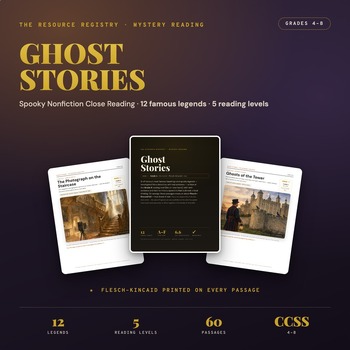
I built our Ghost Stories passages to do both jobs: each one reads like a real ghost story, then the questions send students back to the text to weigh what actually holds up. There are per-grade sets for 4th through 8th so the reading level matches the reader — a ready-made close-reading unit for the fall. Browse the whole hi-lo reading passages library for more high-interest sets.
Want to test it on your class before Halloween? Grab the free sample passage and see who finishes it — and who starts arguing about whether it's true.
The bottom line
Use the hook honestly. A ghost story earns you something precious — a whole class reading closely, willingly — and then hands you the perfect chance to teach them to question a story instead of just enjoying it. That's a close-reading lesson dressed up as a scary one, and it's the kind of thing students remember long after the season's over.