A 5-minute daily morphology routine (Grades 3–6)
Nobody has a spare 30-minute block for morphology. Good news: morphology doesn't want one. It wants five minutes, most days, all year — the exact shape of morning work.
Every upper-elementary teacher knows morphology matters. Once texts turn academic, most of the hard words are built from parts — a student who can take unbelievable apart into un + believe + able has a strategy for a word nobody pre-taught. The problem is never whether to teach it. The problem is when. Your schedule is already full, and "add a morphology unit" is a fantasy.
So don't add a unit. Morphology is one of the rare skills that's actually better in tiny, frequent doses than in a concentrated block — which means it fits the slot you already have: morning work.
A root you meet for five minutes on thirty different mornings sticks. A root you meet for an hour once does not. Frequency beats intensity, and morphology is the clearest example of it.
Why daily-and-short wins
Spacing does the work. Meeting port ("carry") on Monday, then bumping into it inside transport Wednesday and portable the next week, is spaced retrieval — the thing that actually moves a word into long-term memory. A one-and-done lesson gives you none of that.
It spirals naturally. Yesterday's prefix shows up inside today's word. Last month's root reappears in a science text. Short daily practice lets you keep circling back without ever "reteaching."
It's low-stakes, so kids take swings. A five-minute warm-up doesn't feel like a test. Students will guess at an unfamiliar word's meaning from its parts when the cost of being wrong is zero — and guessing-from-parts is the whole skill.
What five good minutes look like
Keep the routine identical every day so it runs itself: one morpheme, a couple of words built from it, and a "predict the meaning of a new word" prompt. Something like — today's root is spect (to look); here are inspect, spectator, spectacles; now: what do you think prospect might mean? Ninety seconds of teaching, three minutes of student work, thirty seconds to share. Then you're into your day.
Sequence the morphemes deliberately — high-frequency prefixes and suffixes first (un-, re-, -tion, -able), then the Greek and Latin roots that build the content-area vocabulary. And spiral relentlessly: today's word should quietly reuse a part from last week.
A year of it, already built
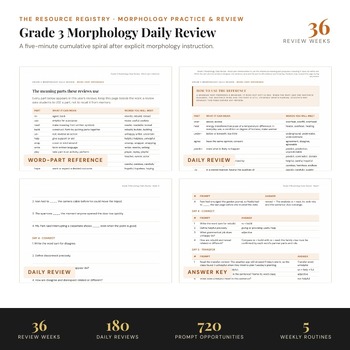
I built our morphology morning work as 36-week, daily bell-ringers for Grades 3, 4, 5, and 6 — one short, self-running page a day, sequenced so each morpheme spirals back and every answer key is included. There's also a full 36-week morphology curriculum per grade if you want the deeper version, plus subject-area units for science and social studies vocabulary.
Want to try a week before committing to a year? Grab a free week of the morning work or a free morphology assessment to see where your students actually land first.
The bottom line
Stop waiting for a morphology block that's never going to appear on your schedule. Give it five minutes at the start of the day, keep the routine the same, and spiral the parts relentlessly. Do that for a year and your students walk into every hard text with a tool for the words no one had time to teach.