Acadience benchmark practice that doesn't feel like test prep (K–6)
Acadience flags who's at risk. It doesn't tell you what to do on Wednesday. Here's how to practice the underlying skills without turning your room into a testing center.
If your district uses Acadience Reading or Acadience Math, you already know the rhythm: benchmark in the fall, again in winter, again in spring, and in between you're supposed to move kids from "below" to "at" goal. The assessment tells you who and which skill. It stays quiet about the part you actually have to do — the daily practice that closes the gap.
The instinct is to drill the test. Resist it. A student who practices only the exact probe format gets better at the probe, not at reading or math. The goal is to strengthen the skill the probe measures, in a form that transfers. Here's how to do that for each strand without the test-prep vibe.
Match the practice to what the measure is really checking
Every Acadience measure is a proxy for a foundational skill. Practice the skill, and the score follows:
Phoneme Segmentation (PSF) and First Sound (FSF) are phonemic awareness. Sixty seconds of oral sound play a day — stretch the word, tap the sounds, swap the first sound — does more than any worksheet. This is ear work, not pencil work.
Nonsense Word Fluency (NWF) is the alphabetic principle: can a child map letters to sounds and blend them? Practice with real decodable words and a few nonsense words mixed in, so kids are decoding, not memorizing.
Oral Reading Fluency (ORF) and Maze are reading connected text accurately, quickly, and with understanding. Repeated reading of short passages and a little Maze-format exposure covers both. Maze especially rewards seeing the format before benchmark day.
Math computation and concepts are number sense and fact fluency. Short, daily, mixed practice beats a weekly worksheet marathon — the fluency piece needs frequency, not volume.
The measure is a thermometer. Practicing the thermometer doesn't lower the fever. Practice the skill it's reading, and the number moves on its own.
Keep it short, frequent, and low-stakes
Five to ten focused minutes a day beats a forty-minute intervention block once a week — especially for fluency, which is built by frequency. Keep the tone light. The moment practice feels like a test, anxious kids tense up and the very skill you're building (automatic, relaxed retrieval) gets harder to reach.
Use progress you can see. A student rereading the same passage on Monday, Wednesday, and Friday can watch their own words-per-minute climb. That visible growth motivates more than any pep talk.
Between-window practice, ready to print
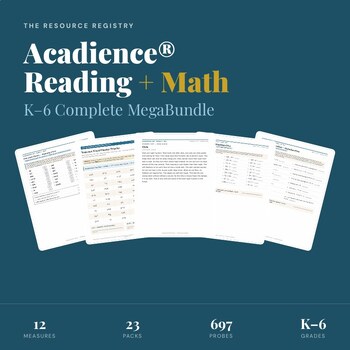
You can't photocopy the official Acadience forms — those are the assessment. So I built an original practice library that mirrors the construction rules of each measure without copying the real probes: Acadience practice packs for FSF, PSF, NWF, ORF, Maze, and Math, with BOY/MOY/EOY sets and the official benchmark goals printed on each sheet so you always know what "at goal" means.
Try the format before you commit — there's a free K–6 goals cheat sheet with five sample probes, plus free single-measure samples for ORF and Math. Run a week of it and see if the numbers move before you buy the full set.
The bottom line
Benchmark data is only useful if it changes what happens Monday morning. Skip the drill-the-test trap, practice the underlying skill in short daily doses, and let students see their own growth. That's how "below benchmark" becomes "at benchmark" — not by practicing the test, but by getting better at the thing the test was measuring all along.
The Resource Registry's Acadience practice packs are an independent product and are not affiliated with, authorized by, or endorsed by Acadience Learning Inc. "Acadience" is a registered trademark of its owner. All passages, items, and probes are original content.