What is the DIBELS 8 Maze test? A teacher's guide (and how to practice it)
Most students who score low on Maze aren't weak comprehenders. They've just never seen the format before benchmark day.
If your school gives DIBELS 8 or mCLASS from second grade up, you've met the Maze subtest — and you've probably watched a capable reader freeze on it. Maze looks nothing like the other DIBELS measures, and that unfamiliarity, not comprehension, is usually what drags the score down. Here's what the subtest actually measures and how to practice it without turning your room into a test-prep factory.
What the Maze subtest measures
Maze is DIBELS 8's silent-reading comprehension measure. The student reads a passage silently for three minutes. Every seventh word or so is replaced with a set of three choices in parentheses — one correct word and two distractors. The student circles the word that keeps the sentence making sense and reads on. It's a timed cloze task, and it runs from Grade 2 BOY all the way through Grade 8 EOY.
The score isn't just "number correct." DIBELS uses an adjusted score: correct answers minus half the incorrect ones (to discount random guessing), and the median of three probes is what counts. That formula surprises teachers who are used to straight accuracy, and it's one more reason practice matters — kids need to learn that guessing wildly to reach the end of the passage actually costs them.
Maze measures comprehension and reading rate at once. A student has to understand the sentence and keep moving. Slow, careful readers and fast, careless readers both struggle — for opposite reasons.
Why students freeze on it
Three things make Maze feel alien the first time:
The format. Parenthetical word-choices mid-sentence don't appear in any normal book. A student who has never seen it spends the first thirty seconds just figuring out what they're supposed to do — thirty seconds off a three-minute clock.
The silence. Unlike ORF, there's no adult listening, no read-aloud. Struggling readers who lean on sounding words out loud lose that crutch.
The clock. Comprehension under time pressure is a different skill from untimed comprehension. Kids who ace a reading-response worksheet can still stall here.
None of those are comprehension problems. They're format problems — and format problems are fixable with a few reps.
How to practice Maze the right way
Make the format routine before it counts. The single biggest gain comes from students simply having seen Maze passages a handful of times. Run a couple of probes in the weeks before a benchmark window so the layout is boring, not baffling.
Teach the "does this make sense?" reread. Model choosing a word, then rereading the whole sentence to confirm it fits. That self-check is the core comprehension skill Maze rewards.
Score with the real formula. Use correct minus half-incorrect so students feel that reckless guessing doesn't pay. It changes how they attack the passage.
Keep it short and grade-leveled. Three minutes, grade-appropriate text, a few times a week for students below benchmark. That's it. Maze practice isn't a curriculum; it's format familiarity plus a comprehension habit.
Where to get practice passages
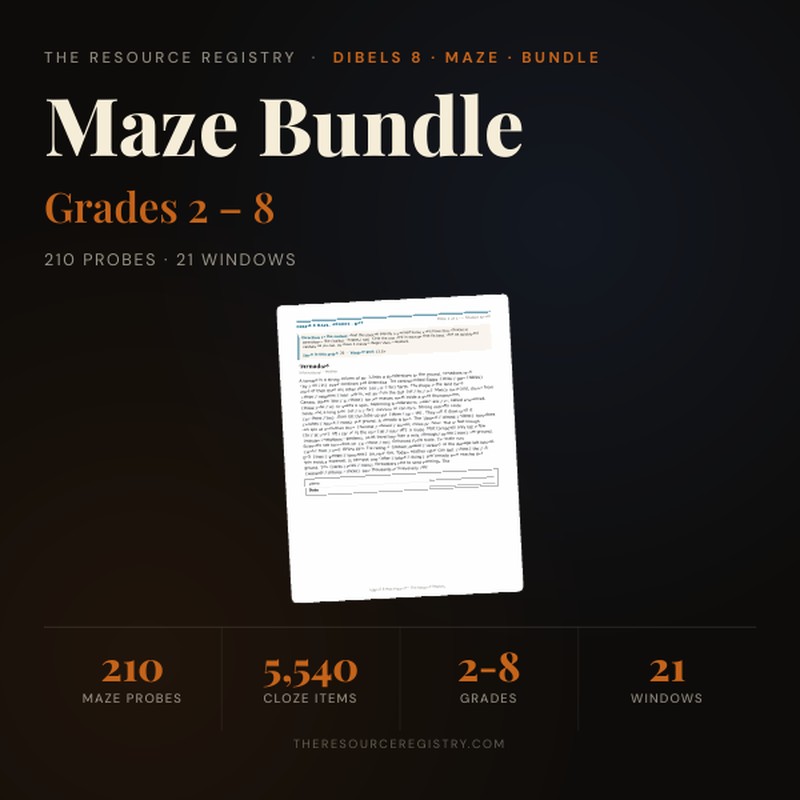
You can't reuse the official Maze forms — they're the assessment. We built an original library instead: DIBELS 8 Maze practice packs with 30 probes per grade (10 per benchmark window), full answer keys, and the official adjusted-score formula printed on every one. There are per-grade packs for 2nd through 8th, a Grades 2–8 bundle for reading specialists, and a middle-school Grades 6–8 bundle for secondary interventionists. There's also a free sample with one probe per grade if you want to try the format first.
The bottom line
Maze is a comprehension measure wearing an unfamiliar costume. Strip away the surprise — a few probes, a rereading habit, and honest scoring — and the number on benchmark day starts reflecting what your students actually understand. That's the whole goal.
The DIBELS 8 practice library is an independent product from The Resource Registry. It is not affiliated with or endorsed by DIBELS, the University of Oregon, Amplify, or Acadience Learning. All passages and probes are original content.