Reading fluency intervention for middle school (Grades 6–8)
By sixth grade the fluency materials dry up — right when your most striving readers still need them most.
Reading fluency is treated like an elementary problem. Most programs, passages, and progress monitors stop around Grade 5. But every middle-school RTI team knows the truth: there are seventh graders reading connected text at a fourth-grade rate, and the gap widens every year they're asked to learn from textbooks they can't fluently decode. The skill is fixable at 13 — the materials are just harder to find.
Why fluency still matters in Grades 6–8
Fluency isn't speed for its own sake. It's the bridge between decoding and comprehension. A student who reads haltingly spends all their working memory on the words and has nothing left for meaning. In middle school, where the reading load explodes across science, history, and ELA, a slow reader falls behind in every subject at once — not because they can't understand the ideas, but because they can't get through the text fast enough to hold them.
DIBELS 8 measures Oral Reading Fluency all the way to Grade 8 for a reason. The skill keeps mattering. The support usually doesn't keep up.
What good middle-school fluency intervention looks like
Age-respecting text. The fastest way to lose a 12-year-old is to hand them a passage about a puppy's birthday party. Middle-school fluency practice needs topics that don't signal "this is for little kids" — real events, science, history, things a teenager would actually read.
Short, repeated, timed reads. The evidence base for fluency is repeated reading: the student reads the same passage a few times across a week, charts words-correct-per-minute, and watches the number climb. Ninety seconds a few times a week beats a long weekly block.
Pair rate with comprehension. Speed without understanding is word-calling. Adding a silent-reading comprehension check — like a Maze cloze passage — keeps the practice honest and catches the kids who are fast but not following the meaning.
Progress-monitor with real benchmarks. Track WCPM and accuracy against the actual Grade 6–8 targets so you know whether the intervention is working, not just whether the student showed up.
Fitting it into an RTI/MTSS block
Middle-school intervention time is scarce. A workable rotation: one timed cold read to establish a baseline, two or three repeated reads across the week to build rate, and a Maze comprehension probe to confirm meaning is coming through. Ten minutes, a couple times a week, per student in Tier 2. Chart it so the student sees their own trajectory — motivation in this age group runs on visible progress.
Where to get Grades 6–8 materials
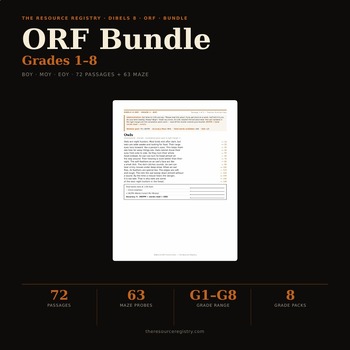
Because grade-appropriate fluency material is the hard part, we built it. Our DIBELS 8 practice library includes original Oral Reading Fluency passages for 6th grade, 7th grade, and 8th grade — each with marked teacher scoring copies and Maze comprehension probes, written with topics that respect the reader's age. There's a middle-school Maze bundle too, if comprehension is your focus. For a change of pace that still builds close reading, the history-mystery escape rooms work well with the same striving-reader group.
The bottom line
Struggling middle-school readers didn't age out of needing fluency support — the field just stopped building it for them. Give them age-appropriate text, short repeated reads, a comprehension check, and a chart that shows growth, and the gap closes. The ceiling on a 13-year-old's reading is a lot higher than the shortage of materials makes it look.
The DIBELS 8 practice library is an independent product from The Resource Registry. It is not affiliated with or endorsed by DIBELS, the University of Oregon, Amplify, or Acadience Learning. All passages and probes are original content.