5-minute daily reading warm-ups that build DIBELS 8 skills (K–1)
The classroom that does two focused minutes every morning beats the one that does forty minutes every Friday. Consistency compounds.
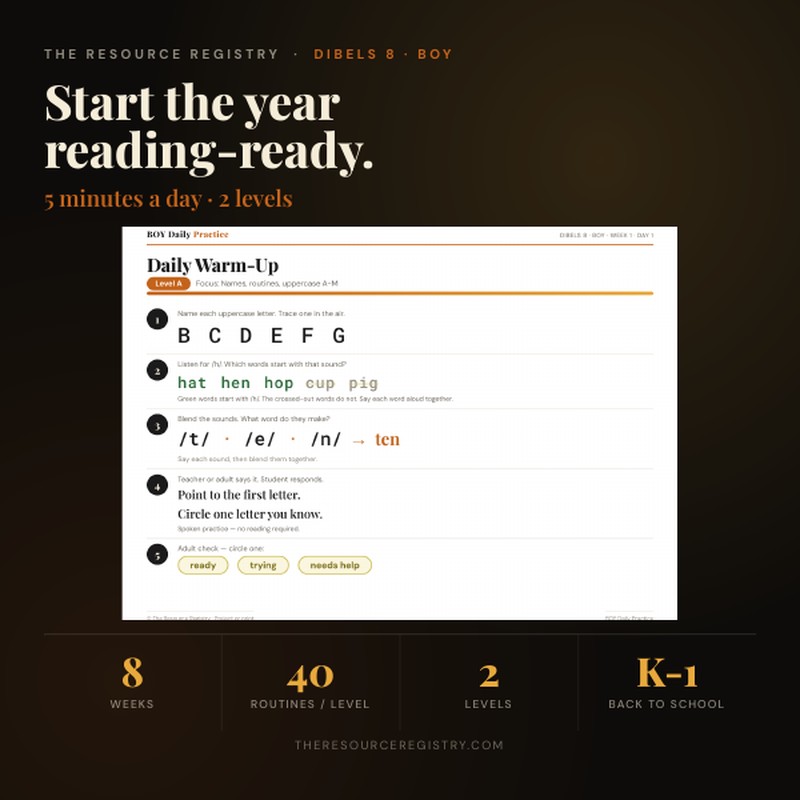
Ask any kindergarten or first-grade teacher what moves reading scores and you'll rarely hear "one big weekly block." You'll hear "the little bit we do every single day." Foundational reading skills — letter names, phoneme awareness, decoding, word reading — are built through frequency, not marathon sessions. A five-minute daily warm-up, done with the whole class, quietly builds exactly the skills DIBELS 8 measures in its early grades.
Why daily beats weekly for foundational skills
Letter-sound automaticity and phonemic awareness are like any motor skill: they respond to distributed practice. Short, frequent reps with a night's sleep in between outperform the same total minutes crammed into one sitting. For a five-year-old, attention is also the limiter — two focused minutes on blending will always beat twenty distracted ones. A daily routine works with both facts instead of against them.
You're not teaching to the test. You're rehearsing the underlying skills so often that the benchmark just happens to measure something the class already does every morning.
What a good K–1 warm-up includes
The early DIBELS 8 measures point straight at what a warm-up should touch:
Letter naming (LNF). A quick pass naming letters keeps recognition automatic so students can spend their thinking on words, not letters.
Sound play and segmenting (PSF). A few seconds of "what sounds do you hear in map?" builds the phonemic awareness that underlies all decoding.
Blending and nonsense-word decoding (NWF). Blending sounds into words — real and made-up — is the skill that separates readers who can decode from readers who've only memorized.
Word reading (WRF). A short list of decodable and high-frequency words builds the automaticity that becomes fluent reading.
Hit those four in rotation, five minutes a day, and you're covering the whole early-literacy foundation before the morning announcements finish.
Making it stick
Same time, same steps. Put it right after arrival or attendance. When the routine never changes, students stop needing directions and the whole thing runs itself.
Project it, don't prep it. A warm-up you have to assemble each night won't survive October. One that projects on the board and needs no copying will.
Differentiate by level, not by kid. A version that's oral-first for your youngest and a slightly harder version for students ready to read lets one routine serve the whole range without singling anyone out.
Send a version home. A parent-friendly page that mirrors the classroom routine turns five school minutes into ten total — and families can actually finish it because they already know the steps.
A routine you can start Monday
We built DIBELS 8 Daily Practice packs to be exactly this: projectable five-minute warm-ups for K–1, two differentiated levels in every pack, with parent home pages. There's a back-to-school pack to start the year, winter and spring packs that ramp with your readers, a summer pack for home, and an all-year bundle. Try a free one-week sample first. If you also need timed probes to monitor progress, the full DIBELS 8 practice library covers every subtest.
The bottom line
You don't need a new curriculum to move early reading scores — you need a small thing you'll actually do every day. Five minutes, four skills, same routine, all year. The benchmark takes care of itself when the practice is already a habit.
The DIBELS 8 Daily Practice line is an independent product from The Resource Registry. It is not affiliated with or endorsed by DIBELS, the University of Oregon, Amplify, or Acadience Learning, and does not report or interpret DIBELS scores.