Why Handwriting Still Matters in K–2 (And the Free Tool That Makes Practice Easy)
Handwriting builds neural pathways typing can't. Why it still matters in K–2 — and a free generator for daily practice.
When a child forms a letter by hand, they're engaging memory, motor planning, and language all at once — something a keyboard simply can't replicate.
Yet handwriting instruction often gets squeezed out of the day. Between reading blocks, math, and the ever-growing list of standards to cover, dedicated practice time can feel like a luxury. And when you do carve out those minutes, the last thing you need is another trip to the copy room for a worksheet that half the class has already finished.
Typing is faster. But hand-writing builds the neural pathway that lets a child read their own writing back.
That's why we built something to make it easier.
The research is clear: handwriting helps kids learn
A growing body of research shows that handwriting by hand — as opposed to typing — plays a unique role in early literacy. Studies from Indiana University found that the process of forming letters activates reading-related circuits in young children's brains in a way that simply looking at or typing letters does not. When children write by hand, they're not just practicing a motor skill; they're reinforcing the shapes, sounds, and meanings of letters and words.
More recent work published in Frontiers in Psychology has shown that students who take notes by hand retain information better than those who type, even in older age groups. For K-2 students who are still building foundational literacy, the benefits are even more pronounced. Handwriting practice strengthens letter recognition, spelling, and even early composition skills.
The takeaway for teachers isn't surprising: regular, consistent handwriting practice matters. But it needs to be low-friction. If preparing the materials takes longer than the practice itself, it's hard to keep it going every day.
What good handwriting practice looks like
Effective handwriting instruction doesn't require elaborate lessons. Research and experienced teachers tend to agree on a few fundamentals.
First, students need a clear model. Showing the correct letter formation — whether it's a printed capital B or a cursive lowercase m — gives students a target. Second, they benefit from guided practice like tracing before they write independently. This scaffolding builds muscle memory without overwhelming beginners. Third, the practice lines themselves matter. The classic three-line format (top line, dashed midline, baseline) helps students understand where letters sit, which ones are tall, which ones drop below, and how consistent sizing works.
Variety helps too. Practicing isolated letters builds formation skills, but students also need to write words, names, and eventually full sentences to transfer those skills into real writing. And for schools that still teach cursive — which many are reintroducing after years of decline — having a separate cursive track is essential so students don't confuse the two scripts.
The challenge has always been logistics: creating, printing, and differentiating all of these worksheet types takes time that most teachers simply don't have.
A free tool that does it for you
We created the Handwriting Practice Generator to solve exactly this problem. It's a single HTML file that opens in any web browser and creates printable handwriting worksheets on demand — no internet required, no accounts, no subscriptions.
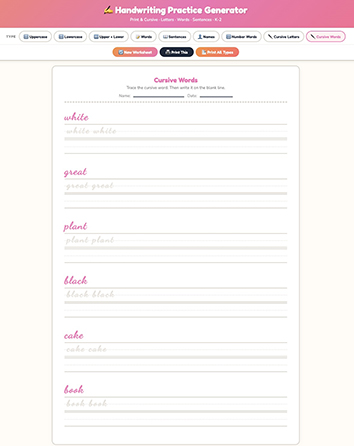
Here's how it works: you open the file, choose from 9 practice modes, and click print. That's it. Every time you click "New Worksheet," it generates a completely fresh page with randomized content. You'll never print the same worksheet twice.
The 9 modes cover the full progression of handwriting skills:
For print handwriting, there are seven modes. Uppercase Letters and Lowercase Letters let students practice individual letterforms. Upper + Lower pairs both cases side by side. Words mode pulls from a bank of over 70 age-appropriate K-1 vocabulary words. Sentences mode offers 30 kid-friendly sentences for copy practice. Names mode helps students practice writing proper names with correct capitalization — perfect for the beginning of the year. And Number Words covers one through twenty.
For cursive, there are two dedicated modes: Cursive Letters for individual letterforms and Cursive Words for putting them together into familiar vocabulary.
Every worksheet follows the same clean structure: a color model at the top of each row, a gray traceable version on guided lines, and a blank set of lines below for independent writing. The three-line format matches standard handwriting paper, so the skills transfer directly to other classroom writing.
How teachers are using it
The tool was designed to fit into the routines teachers already have, not add another one. Here are a few ways it works well:
As a daily warm-up. Click New Worksheet each morning and print a fresh page. It takes about 10 seconds. Students have something meaningful to do the moment they sit down, and you get a few minutes to take attendance or prep for the first lesson.
For differentiation. Not every student is at the same level, and that's fine. Pull up letter practice for students who are still working on formation, and sentence practice for students who are ready to write longer text. Since every click generates a new page, you can print different sheets for different groups without any extra prep.
As a homework resource. Click "Print All Types" and you have a 9-page handwriting packet ready to go. Send it home for the week, over breaks, or over the summer. Parents appreciate having structured practice, and it's zero effort for you.
For cursive introduction. If your school is reintroducing cursive — as many are — the two cursive modes give you an easy starting point. Begin with Cursive Letters until students are comfortable with the letterforms, then move to Cursive Words.
In literacy centers. Station a laptop or tablet at a handwriting center and let students generate and print their own worksheets. They love clicking the button and seeing new content appear.
Why we made it free
We believe foundational tools should be accessible. Handwriting practice isn't a premium skill — it's something every young learner needs, and every teacher should be able to provide without digging through filing cabinets or spending money on worksheet packs. One file, unlimited worksheets, forever.
The Handwriting Practice Generator is available as a free download in our TPT store, The Resource Registry. If you find it useful, a quick review helps other teachers discover it too.