Why most phonics passages break their own rules (and what we did differently)
A 'decodable' passage that contains untaught patterns isn't decodable. Here's why scope-and-sequence matters in phonics, and what a strict version looks like.
A first grader sits down to read a "decodable" passage their teacher pulled from a popular worksheet site. The pack is on consonant digraphs — sh, ch, th. The passage uses those patterns. Good. It also contains the words smart, right, and her. Those words depend on r-controlled vowels and silent E — patterns the kid hasn't been taught yet.
The lesson collapses, but not the way you'd expect. The kid sounds out the digraphs fine. Then she hits smart and freezes. The teacher prompts her to "sound it out," but s-m-a-r-t doesn't blend the way she's been taught. She guesses. She guesses wrong. The teacher says "no, it's smart." The kid feels behind. So does the teacher.
The kid isn't behind. The passage broke its own rules.
If a passage is labeled decodable but contains words that depend on patterns the student hasn't been taught, the practice isn't phonics practice. It's a guessing test in a phonics-shaped frame.
The scope-and-sequence problem
In structured phonics, the word "decodable" has a specific definition. A text is decodable when every single word in it falls into one of two categories: either it can be sounded out using patterns that have already been taught, or it's an explicit heart word the student has memorized.
That's it. Two categories. Anything else is not decodable.
This sounds obvious until you go looking for K-2 phonics passages online. Most of what you'll find — even from publishers with strong reputations — quietly slips in words that violate the rule. Sometimes it's because they assumed earlier patterns had been taught. Sometimes it's because the writer wanted a more interesting passage and grabbed words that "felt easy." Sometimes it's because nobody actually checked.
The result is the same: kids encounter passages where the rules they've been taught don't fully work, and the only way through is to guess. Which is exactly the cueing strategy structured phonics is supposed to replace.
Why this matters more than it sounds
You might be thinking: so what? One mystery word in a passage isn't a disaster. The kid moves on.
It would be fine if the cost were just that one word. The cost is bigger.
Phonics instruction works because it builds a reliable system. The kid learns that letters represent sounds in predictable ways, and that the predictability lets them decode words they've never seen before. The whole reason it works is that the rules hold.
When the rules don't hold — when "decodable" passages contain untaught patterns — kids learn a different lesson. They learn that the rules sort of work, but you also have to guess sometimes. Or memorize. Or look at the picture. Which means the system isn't reliable, which means you have to fall back on the guessing strategies that structured phonics is designed to replace.
For a kid who would have decoded fine, this is annoying. For a kid who's struggling, it's the difference between believing the system works and giving up on it.
What strict scope actually requires
Building genuinely decodable phonics materials isn't complicated. It's just tedious in a way that most curriculum publishers haven't been willing to do.
You need three things. First, an explicit declared scope — a list of every grapheme-phoneme correspondence that's been taught up to this point in the sequence. Second, an explicit heart word list — the specific irregular words the student has memorized through direct instruction. Third, a validator that runs against every word in every passage, every word list, every dictation sentence, before the pack ships.
If a word can be decoded using the declared scope, it passes. If it's on the heart word list, it passes. If it's neither, it fails — and either the word gets cut or the scope gets expanded (and then everything previous gets re-validated against the new scope).
This is mostly engineering, not pedagogy. But it's the engineering that determines whether your phonics actually works.
The Skill Path: what each section runs through
Once the scope is solid, the instructional routine that uses it matters too. Across the Sound-to-Story line, each section of each pack follows the same Skill Path:
Teach — direct, explicit instruction of the new pattern, with the keyword and the heart words for that section called out.
Blend — students read word lists in the new pattern, working from controlled CVC-style structures into more complex words.
Map — phoneme-grapheme mapping. Students tap and write one sound per box, building the connection between the sounds they hear and the letters that represent them.
Dictate — students write words and sentences the teacher reads aloud. This is the inverse of reading and a far better test of mastery than reading alone.
Read — connected text. Two short, fully decodable passages per section.
Reread — fluency practice. WCPM tracked across four reads of each passage.
Check — a 20-word mastery quick-check with a clear scoring rule. 18-20 correct means move on. 15-17 means review the trouble patterns and re-check. Below 15 means re-teach the section before moving forward.
This isn't a TRR invention. It's the structured phonics routine that decades of research on the Science of Reading converges on. What we did was build the materials to run it, with the scope-and-sequence discipline that most existing packs skip.
What the 10-pack arc covers
The line is structured as a K-2 progression. Each pack builds on the patterns taught in the previous pack, and the heart word lists carry forward.
Pack 1 — CVC Short Vowels (K). All five short vowels in CVC words. Where every structured phonics journey starts.
Pack 2 — Consonant Digraphs (K-1). sh, ch, th, wh. The first multi-letter graphemes.
Pack 3 — FLOSS + Closed-Syllable Endings (K-1). The FLOSS rule (double f, l, s, z at the end of one-syllable words) plus -ck, -ng, -nk endings.
Pack 4 — Beginning + Ending Blends (K-1). S-blends, l-blends, r-blends, and final blends. The point where many kids start sounding like real readers.
Pack 5 — Silent E (G1). Long a, i, o, u via the a_e, i_e, o_e, u_e pattern.
Pack 6 — Vowel Teams (G1). ai, ay, ee, ea, oa, ow, ie, igh. The first major shift from one-sound-per-letter into more complex spellings.
Pack 7 — R-Controlled Vowels (G1-G2). Bossy R: ar, or, er, ir, ur. The vowels that aren't quite vowels.
Pack 8 — Diphthongs + Variant Vowels (G2). oi, oy, ou, ow, oo, au, aw. The "weird" vowel patterns that resist neat rules.
Pack 9 — Syllable Types + Suffixes + Morphology (G2). Open syllables, -ed, -ing, -le syllables, plus introductory morphology. The biggest concept jump in the line.
Pack 10 — Big Kid Decodables (G2-G3 Intervention). Mystery and adventure passages designed for older readers still building fluency. Higher-interest content, controlled scope.
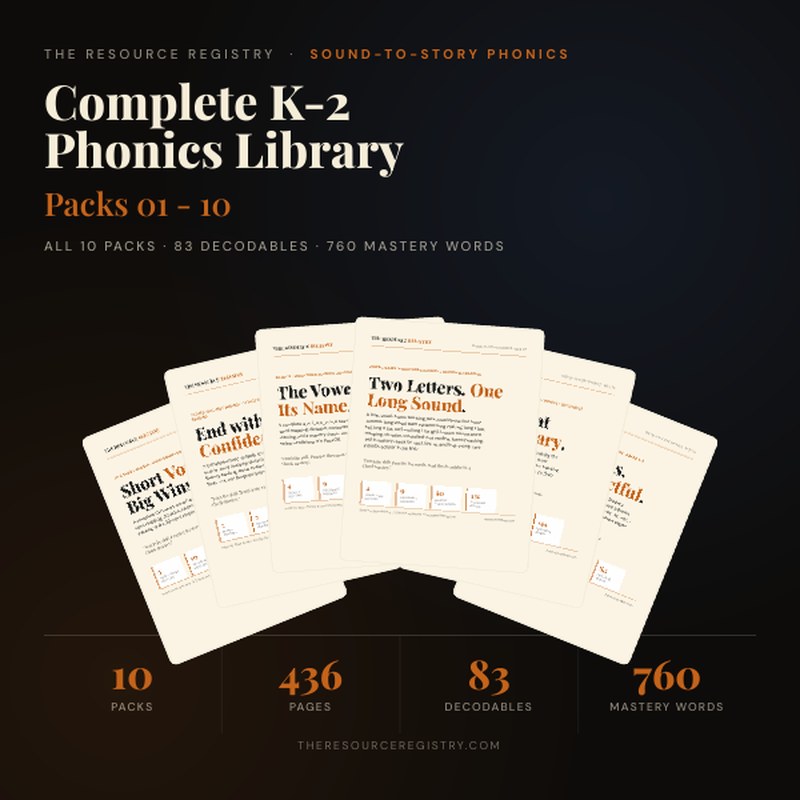
Together: 436 pages, 83 decodable passages, 760 mastery-check words, 5,070 passage words. Every word validated against the declared scope and the heart word list before the PDF ships.
Heart words — the only allowed exception
One question always comes up: what about words like the, of, have, said? Those don't follow the rules either.
True. Those are heart words — high-frequency words with irregular spellings that have to be memorized in advance. Every pack declares its heart words explicitly at the section level, and they're introduced through direct instruction before they appear in passages.
Heart words aren't a loophole. They're a small, declared, taught exception — and the list is kept short. The CVC pack uses heart words like the, a, I, to, is. Not smart. Not right. Not her. Those are pattern-based words that get taught when the pattern gets taught.
Why this took so long to build
Honestly? Most of the time wasn't writing the passages. It was writing the validator that checked them — and then iterating on the scope and the passages until the validator stopped flagging things.
The first CVC pack passed validation on the fourth rebuild. The Vowel Teams pack took eleven. By the time we got to the Mega Bundle — the Complete K-2 Phonics Bundle — the rebuild process was running automated against every word in every passage in every pack, every time we changed anything. Tedious, but it's the difference between a passage that's labeled decodable and a passage that actually is.
If you want to try the format first, there's a free Sound-to-Story Sampler that runs the full Skill Path on one short-vowel section. It's not a teaser preview — it's a real working section from the line, with the same scope discipline applied. Try it. If it feels like it fits how you teach phonics, the full packs ship the same way.
The point
Scope-and-sequence discipline is unsexy. Nobody markets a phonics pack by saying "we made sure every word in every passage was decodable using only previously taught patterns." It doesn't fit on a thumbnail. It doesn't trend on Pinterest.
But when a kid sits down with a passage they can actually decode from end to end, something shifts. The struggle disappears. The cueing strategies stop being needed. What's left is the work of reading — actually decoding, actually blending, actually reading. Which is the whole point of phonics in the first place.
Sound-to-Story Phonics is independent content from The Resource Registry. All passages, word lists, and instructional materials are original.