Stop hunting for math worksheets every Sunday: the case for a generator
PDF worksheets break the moment you try to differentiate or reuse them. Here's why a math generator quietly outperforms — and how to actually use one.
It's Sunday night. You need a 1st-grade two-digit addition worksheet for Monday's small group. Ideally one with regrouping, ideally with an answer key, ideally not the same one you printed in February. You open three tabs. One's behind a paywall. One has the right topic but the layout is a mess. One's free and clean but the problems repeat. Forty minutes in, you give up and start customizing one in Google Docs.
We've all done this. And it keeps happening because the way most math worksheets are built — as fixed PDFs with a single set of problems — fights against the way teachers actually use them.
A good math worksheet should be easy to differentiate, easy to reuse, and the answer key should never be on a separate file you have to hunt for. That's the whole bar. Most worksheets don't clear it.
Why PDF worksheets break
The fundamental problem with the PDF format is that one PDF equals one fixed set of problems. That sounds obvious, but it cascades into everything teachers complain about.
Reusing is hard, because kids memorize the answers. You can flip the page upside down or change the font, but if it's the same eight problems in the same order, the third graders who saw it Monday will breeze through it on Wednesday. You're not measuring math; you're measuring memory.
Differentiation requires three downloads, not one. Easy version, medium version, hard version — all separate PDFs, often from different sites, usually inconsistent in layout. The kid who needs scaffolding gets a sheet that looks completely different from the kid sitting next to them. Sometimes that's fine. Often it tips off who's in which group, which isn't fine.
Answer keys are a separate file. Or they're on page 2 and you have to remember to remove them before copying. Or they exist somewhere on a teachers-share Google Drive that you can never find when you actually need it.
None of these are crises. They're just papercuts. But they're papercuts you take every week for ten months. Across an elementary career, that's hundreds of hours of friction.
What a generator changes
A worksheet generator is what it sounds like: a tool that produces a fresh worksheet on demand. Click a button, get new problems. Click again, get different new problems. The math doesn't change — addition is still addition — but the specific numerals on the page do.
That one shift unblocks most of the papercuts:
Reuse without memorization. The 2nd grader who saw two-digit subtraction last Friday gets a different set of two-digit subtraction problems on Monday. Same skill, fresh numbers. The practice still counts.
Differentiation in two clicks. Pick the topic, pick the difficulty (Easy / Medium / Hard), print. Three students, three difficulty levels, one tool. Same layout, same fonts, same paper — no obvious tracking by who got which sheet.
Answer keys, every time, in the same place. The print job is two pages: the worksheet on page 1, the answer key on page 2. Always. No separate download. No "I'll check it later" because checking is now a 10-second glance.
Topic granularity. Most PDF worksheet packs lump everything into "1st grade addition" with maybe 5-6 worksheet variations. A generator can split that into separate topics — addition within 10, addition within 20, two-digit without regrouping, two-digit with regrouping, three-digit, mental math, word problems, fact families — each with its own difficulty scale. You stop fighting against the lumping and start hitting the exact skill you're working on.
Where generators fall short
A generator isn't a magic wand. There are a few places where a hand-designed PDF still wins.
Scope-and-sequence units. If you're teaching a structured unit where problem sequencing matters — say, a multi-day arc that builds from concrete manipulatives to abstract notation — a thoughtful PDF curriculum gives you the pedagogical sequencing a generator can't. Generators are great for practice. They're not curriculum.
Engaging one-offs. Math art projects, themed seasonal worksheets, color-by-answer activities. These thrive on careful design and visual polish that a generator can't match. Hold onto a few of these for Fridays and end-of-unit days.
Specific assessment items. If you need a specific item type — say, a particular kind of word problem or a fraction model that pairs with a specific tape diagram — a generator might not produce it. Custom items still need custom design.
The right answer is to use both. Generators for daily practice, intervention, warm-ups, differentiation, and homework. Curated PDFs for structured units and the occasional "let's do something different today." This isn't a fight between two approaches; it's a question of which job each one is better at.
What good math worksheets look like (regardless of format)
A few principles that hold whether you're printing from a generator or a PDF pack:
Concrete-to-abstract progression. Early-elementary worksheets should still show the manipulative model alongside the equation. A 1st grader doing two-digit addition benefits from ten-frames or place-value blocks pictured on the page, at least at the Easy and Medium levels. Strip the visuals only when the abstract notation is solid.
Whitespace is not wasted space. Tight packed problems look efficient and are anything but. Kids need room to write, room to draw their work, room to make a mistake and erase it. A worksheet with 30 problems crammed into a half page is worse practice than 12 problems with breathing room.
The right number of problems. Roughly 8-12 for K-2, roughly 12-20 for 3-5. More than that and you're teaching endurance, not math. If a kid does the first 8 well, you have your answer; making them grind through 24 more doesn't make them stronger.
Real answer keys. Not "see teacher manual." Not "answers vary." Real ones. A worksheet without a usable answer key is a worksheet that's going to take you ten minutes to grade for each student, which means it's a worksheet you're going to stop using by November.
The tool we built
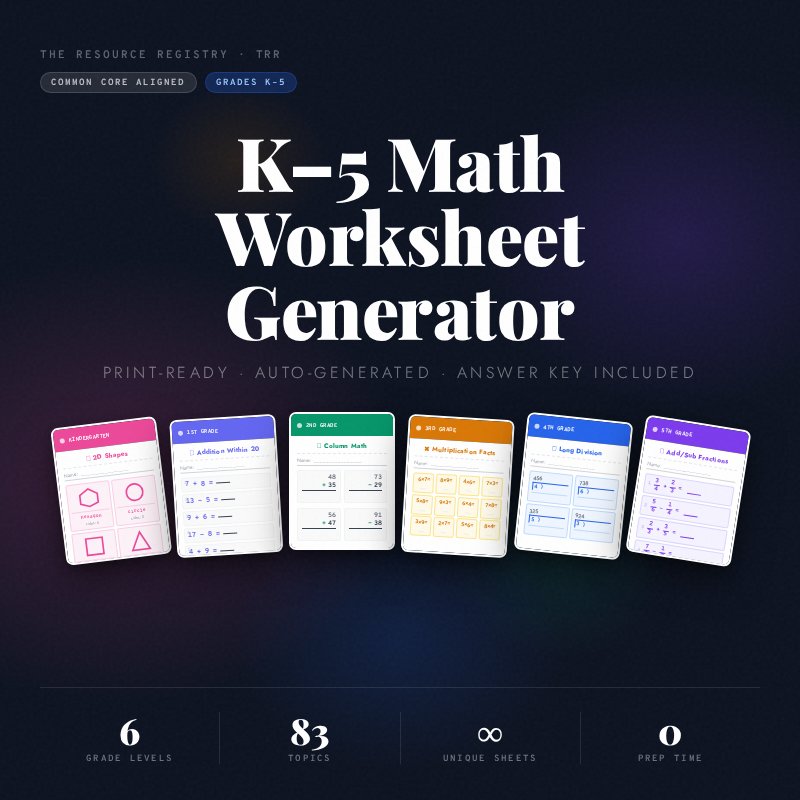
We made our generator-based practice worksheets after spending a year switching between six separate grade-level generators and realizing nobody — teacher, tutor, or parent — actually wants six browser tabs open. The bundle is one HTML file with a sidebar grade selector and 109 topics across all six grades (K-15 topics, 1st-19, 2nd-16, 3rd-19, 4th-21, 5th-19). Three difficulty levels per topic. Auto answer keys on page 2. Print a single topic, or batch-print every topic at the current grade.
It runs in any browser, offline, no login. Open the file in Chrome or Safari and it works. We made it because we wanted a tool that did one thing well: produce fresh, properly-formatted math practice without making us think about it. If you teach a multi-grade classroom or have a sibling group at home, one file covering K-5 is also just easier than six.
If you want to try the format first, the standalone Kindergarten generator is $3 and gives you a feel for the whole system.
The bottom line
Worksheet practice isn't going anywhere in elementary math. The research on retrieval practice and spaced repetition keeps saying what every veteran teacher already knows: kids need to do problems, regularly, to make math stick. The question isn't whether to use worksheets. It's whether the worksheets you're using are working for you, or wasting your Sundays.
A generator solves the Sunday-night problem. It doesn't solve teaching. But once it's running in the background, you can spend that Sunday hour on the part that actually requires you — planning the small-group conversation, sequencing the unit, calling the parent — instead of hunting through Pinterest for a worksheet that still won't quite fit.