History-mystery escape rooms: close reading Grades 3–7 actually want to do
The trick to getting reluctant readers to reread a passage three times? Tell them the answer is hidden in it.
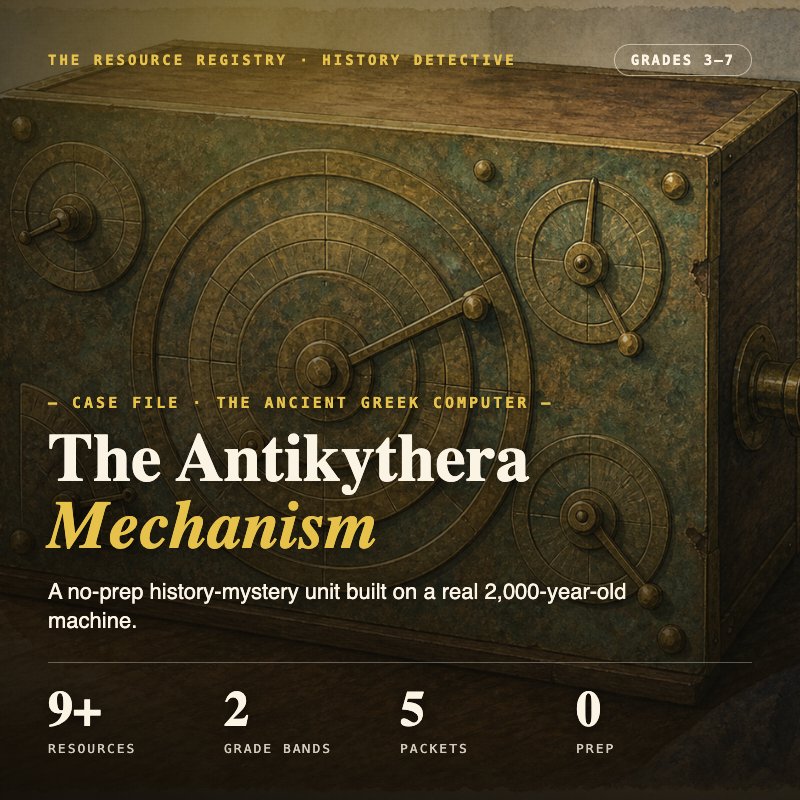
Ask a class of fifth graders to closely reread a nonfiction passage and annotate the evidence, and you'll get groans. Tell them a two-thousand-year-old Greek device is hiding a code they can only crack by reading carefully, and the same kids will reread it four times without being asked. That's the whole idea behind a history-mystery escape room — the reading rigor stays; the resistance disappears.
What a paper escape room actually is
Forget physical locks and boxes. A print-and-go escape room is a sequence of short nonfiction passages, each followed by a puzzle whose answer can only be found by reading the text closely. Solve the puzzle, unlock the next "room," advance the mystery. Students work in small groups, argue over evidence, and reread constantly — because the text is the key, not an obstacle between them and the fun.
Engagement isn't the opposite of rigor. The best puzzle formats smuggle the rigor inside something students are motivated to finish.
The reading skills hiding in the fun
Close reading. Students reread each passage multiple times because the puzzle demands specific details. That's the exact behavior close-reading lessons try — and usually struggle — to produce.
Citing evidence. Every puzzle answer has to be justified from the text. Kids learn to point to the sentence, not guess.
Fact vs. theory. Real historical mysteries — the Antikythera mechanism, the Mary Celeste, the Lost Colony of Roanoke — come with genuine uncertainty. Students practice separating what's documented from what's speculated, a core critical-thinking and informational-text standard.
Inference and synthesis. The final "escape" usually requires combining clues from several passages, so students synthesize across a whole text set, not just one paragraph.
How to run one in your classroom
Groups of three or four. Big enough to debate the evidence, small enough that everyone reads. Mixed reading levels work well — stronger readers pull the text along, and the discussion carries everyone's comprehension.
Let them be stuck. The productive struggle is the point. Resist handing out the answer; nudge them back to the passage instead. "Where in the text could that be?" is the only hint you need most of the time.
Debrief the reasoning. After the escape, spend five minutes on how groups knew — which sentence, which clue, what they rejected and why. That's where the transferable skill gets named.
Use them as a reward that isn't a reward. A Friday escape room feels like a treat to students and reads like a full close-reading lesson on your plans. Everybody wins.
Where to start
We build these as no-prep, no-lock history mysteries for Grades 3–7 — real unsolved cases, original nonfiction passages, and puzzles keyed to the text. Browse the full set on the Escape Rooms / History page: the Antikythera Mechanism, the Voynich Manuscript, and the Lost Colony of Roanoke. New to the format? Start with the free Mary Celeste escape room — the whole structure, at no cost, so you can run it once and see how your class responds.
The bottom line
Close reading doesn't have to be a fight. Wrap a real historical mystery around a demanding text, make the reading the key to the puzzle, and students will do the rigorous work happily — because to them, it isn't a worksheet. It's a case to crack.
History Detective escape rooms are original products from The Resource Registry.