DIBELS 8 practice between benchmark windows: what actually helps
DIBELS 8 told you what to worry about. Practice has to do the rest — and most of what's online isn't built for the job.
Your benchmark window closes. A handful of kids are at risk on NWF. Two more dipped below the WRF cut score. One first grader has been hovering at the ORF benchmark since November and you can't tell if it's a fluency issue or a comprehension issue. You know what the data says. You also know what comes next: weeks of practice between now and the middle-of-year window, with whatever materials you can scrounge up.
Here's the problem nobody warns you about. You can't reuse the official DIBELS passages — they're the assessment. Most of what's online labeled "DIBELS practice" is either repackaged test prep, low-quality original content, or word lists scraped together without much care for scope. So Sunday night becomes a hunt for something — anything — that mirrors the subtest format closely enough to be useful.
DIBELS predicts reading because it measures the skills that drive reading. Practice for the skills, not the test.
Why "test prep" is the wrong frame for DIBELS
DIBELS isn't a test in the way a state assessment is. It's a series of one-minute probes that sample the underlying skills predictive of reading success. LNF measures letter knowledge. PSF measures phonemic awareness. NWF measures grapheme-phoneme decoding. WRF measures word reading automaticity. ORF measures connected text fluency and (with the optional Maze) silent comprehension.
The reason DIBELS scores correlate with later reading isn't magic. It's that those five things — letter knowledge, phoneme awareness, decoding, automaticity, fluency — are reading. Get them solid and the score follows. Drill the test items without strengthening the underlying skill and the score might tick up briefly, then stall.
That's why the practice that works isn't really "DIBELS prep" — it's targeted skill practice that happens to look a lot like the subtests, because the subtests look a lot like reading.
What good DIBELS practice looks like
A few principles separate practice that transfers from practice that just keeps kids busy.
Mirror the subtest format, but with original items. If a kid is struggling on NWF, they need timed 1-minute probes with VC and CVC nonsense words. If they're struggling on ORF, they need 1-minute reading of a grade-appropriate connected passage. The format matters because the format is what tests automaticity. Untimed practice is fine for accuracy. Automaticity is what DIBELS measures, and timed practice is what builds it.
Short and frequent beats long and occasional. Two minutes a day, three days a week, on the skill at risk. That's it. The kid who needs WRF practice doesn't need a 30-minute pull-out — they need 90 seconds with a fresh word list, three or four times a week, with someone marking errors.
Score live and reteach the misses. The point of timed practice isn't the score on the page. It's catching the words and patterns the kid is still struggling with so you can go back and reteach. If a first grader keeps stalling on closed-syllable -ck endings, that's not a fluency problem. That's a phonics gap pretending to be a fluency problem.
Track trajectory, not just hit-the-cut-score. A kid moving from 12 WCPM to 28 WCPM over six weeks is doing great, even if 28 is still below the EOY benchmark. Trajectory tells you whether instruction is working. Cut scores tell you whether the kid needs more.
The five subtests, briefly
If you're new to DIBELS 8 — or new to a grade you haven't taught before — here's the quick orientation.
LNF — Letter Naming Fluency (K, Grade 1). One minute of naming letters from a randomized grid. Builds the automaticity that lets early readers stop thinking about letter recognition and start thinking about words. Not predictive past 1st grade, but critical early.
PSF — Phonemic Segmentation Fluency (K). The examiner says a word; the student segments it into individual phonemes. "Cat" → /c/ /a/ /t/. PSF is the only DIBELS 8 subtest with required audio, because the examiner speaks the word and the student responds aloud. It's a pure phonemic awareness measure.
NWF — Nonsense Word Fluency (K through Grade 3). Made-up CVC and VC words like lat, mip, sog. The kid can either read sound-by-sound (letter-sound correspondence credit) or read the whole word (whole-word read credit). NWF separates kids who can decode from kids who've memorized real words but can't sound out anything new.
WRF — Word Reading Fluency (K through Grade 3). Real high-frequency and decodable words, read in one minute. This is automaticity: how fast can the student access the word without having to decode it letter-by-letter every time.
ORF — Oral Reading Fluency (Grade 1 through Grade 8). Connected text. One minute of reading a grade-leveled passage. The most commonly cited DIBELS measure because it's the closest analog to actual reading. Grade 2 and up also includes a Maze passage — silent reading with multiple-choice cloze items — as a comprehension proxy.
How often, how much
For students at benchmark, no extra practice is needed. The classroom literacy block is doing its job. Keep the benchmark assessments and move on.
For students below benchmark or well below, here's a starting cadence:
Two to three probe sessions per week, 1-2 minutes each. Same subtest. Same student. Different items each time so they're not memorizing. Score live. Mark errors and re-teach the underlying skill at the next small-group session — not by drilling the missed word, but by re-teaching the pattern (e.g., if they missed three CVC words ending in -ck, go back and re-teach the -ck pattern with mapping and dictation).
Six to eight weeks of this, paired with strong Tier 1 phonics instruction, usually moves the needle. If it doesn't, that's a sign the underlying instruction needs to change — not that the practice needs to be longer.
What we built — and why
We made a full DIBELS 8 practice library because we got tired of teachers asking us where to find legal, useful, original practice between benchmark windows. So we built it: original 1-minute probes for every subtest, every benchmark window (BOY/MOY/EOY), Kindergarten through Grade 8. Grade-level bundles if you only need one grade; subtest bundles if you only need one skill; or the full K-G8 Mega Bundle if you're a school or interventionist who needs the whole library.
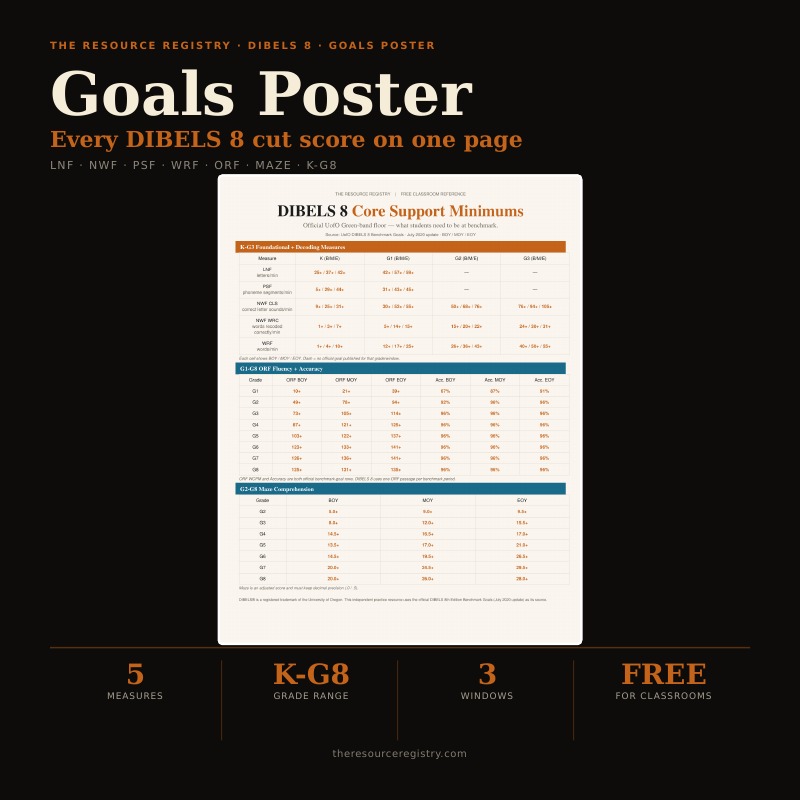
Two things worth knowing. First, every passage and word list is original — written specifically to mirror DIBELS 8 difficulty progression, not lifted or recycled. Second, there's a free DIBELS 8 Goals Poster that puts every benchmark cut score on one page — K through Grade 8, every subtest, every window. That's been our most-downloaded freebie this spring; teachers print it once, laminate it, and keep it on the small-group table.
The free Grade 3 ORF sample lets you try the format before you buy anything — one passage and one Maze probe, ready to print.
The honest bottom line
DIBELS isn't perfect. No screener is. It tells you where kids are on a narrow slice of reading skills at three points a year. But that slice happens to be the foundation, and the kids who can't do it usually can't do the rest either. Practice that strengthens the slice — the right amount, often enough, on the kid in front of you — does what no amount of test prep ever could: it makes them better readers.
That's all DIBELS practice is supposed to do. Skip the gimmicks and the test-prep packets. Find a few minutes a day. Use materials that mirror the format. Track what changes. The rest takes care of itself.
The Sound-to-Story Phonics line and the DIBELS 8 practice library are independent products from The Resource Registry. They are not affiliated with or endorsed by DIBELS, the University of Oregon, Amplify, or Acadience Learning. All probes, passages, and word lists are original content.