10 Fun Math Games for Kindergarten That Actually Feel Like Play
Ten kindergarten math games that build number sense without feeling like worksheets. Use them in centers, at home, or as transition fillers.
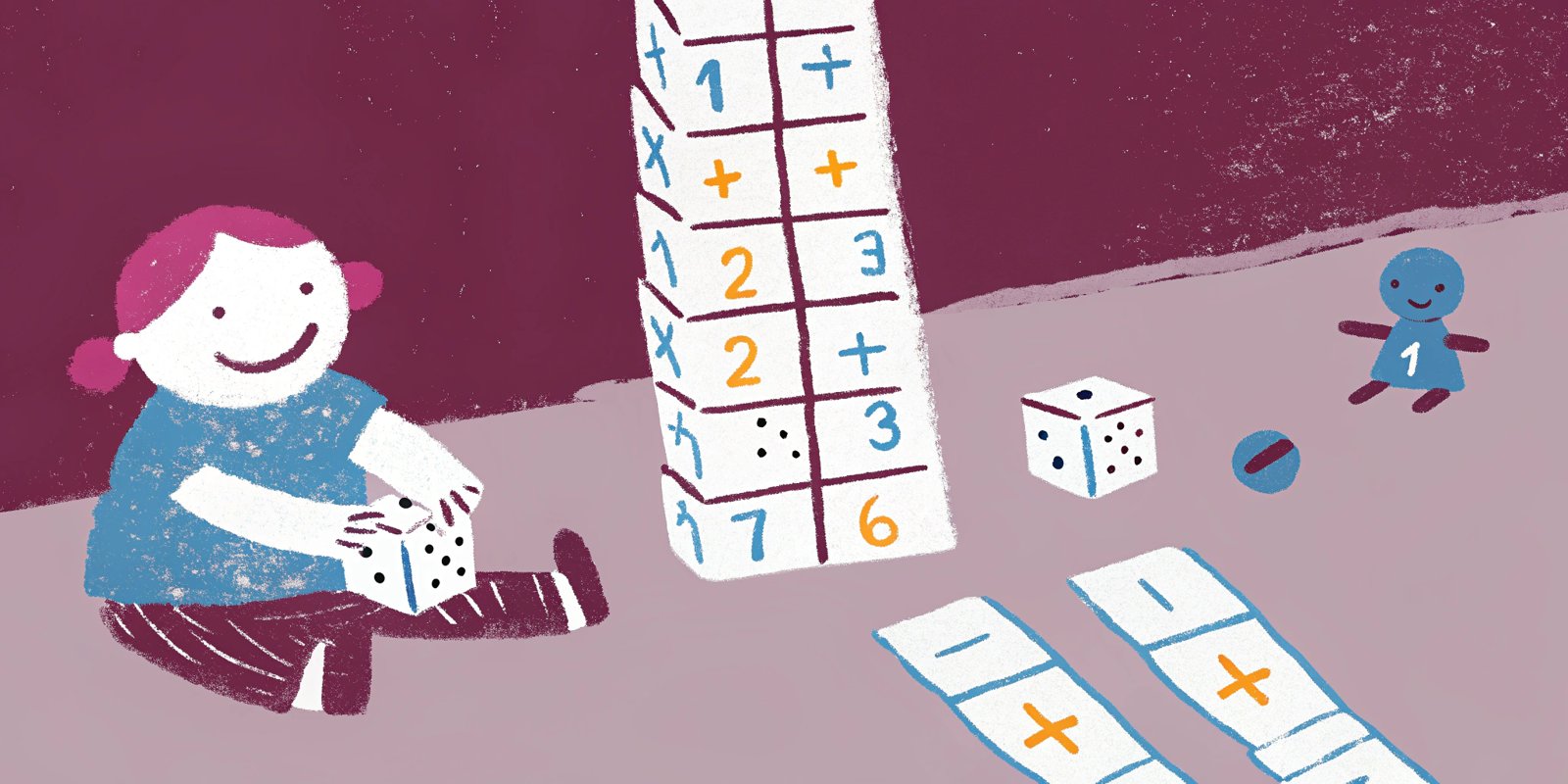
Kindergarteners don't learn by sitting still and filling in worksheets for 30 minutes. They learn by touching things, moving things, arguing over whose turn it is, and accidentally learning to add while they're busy having fun.
If a five-year-old can tell it's math, you've already lost them. The best K math games look like games — and teach number sense as a side effect.
The good news? You don't need fancy resources or hours of prep to make maths engaging. Some of the best maths games use things you've already got — dice, cards, building blocks, and a bit of imagination.
Here are 10 of our favourites. They're low-prep, high-engagement, and they cover the key skills kindergarteners need to build: counting, number recognition, addition, subtraction, comparing, and shapes.
1. Dice Wars
What you need: Two dice per pair of children.
How to play: Each child rolls a die. Whoever rolls the higher number wins both dice for that round. If they roll the same number, they roll again.
Why it works: It's fast, it's competitive (in the best way), and children are practising comparing numbers every single round — without even realising it. You can level it up by having them roll two dice each and add them together before comparing.
2. Number Scavenger Hunt
What you need: Number cards hidden around the room (or playground).
How to play: Hide number cards around the space. Children hunt for them and bring them back. Once they've found them, they put them in order from smallest to biggest.
Why it works: It gets them moving, it builds number recognition, and the ordering task at the end reinforces number sense. You can adapt it by hiding two sets and asking children to match pairs, or by hiding numbers and asking them to find the one that comes before or after a given number.
3. Build It, Count It
What you need: Building blocks (Lego, Duplo, wooden blocks — whatever you've got).
How to play: Call out a number. Children race to build a tower with exactly that many blocks. Then they count to check.
Why it works: It connects counting to something physical. Children can see and feel the number. You can extend it by asking, "Can you add two more? How many now?" and suddenly you're doing addition without anyone complaining.
4. Snack Time Maths
What you need: Small snacks — raisins, crackers, grapes, cereal pieces.
How to play: Give each child a small pile of snacks. Ask them to count how many they have. Then ask: "If you eat two, how many will you have left?" Let them eat the two, then count again.
Why it works: There is no more motivating maths manipulative than food. Subtraction suddenly makes perfect sense when it means eating something. This works beautifully for early addition too — "Your friend gives you three more. How many now?"
5. Shape Detectives
What you need: Nothing — just the classroom (or wherever you are).
How to play: Call out a shape — circle, square, triangle, rectangle. Children have 30 seconds to find something in the room that matches. They point to it, name it, and explain how they know.
Why it works: It takes geometry off the worksheet and into the real world. Children start seeing maths everywhere, which is exactly what you want. The explaining part builds mathematical language too — "It's a rectangle because it has four sides and two are longer."
6. Ten Frame Shake-Up
What you need: A ten frame (drawn on paper or a whiteboard) and ten two-colour counters (or coins, buttons — anything with two sides).
How to play: Put ten counters in a cup, shake them up, and pour them onto the table. Sort them by colour into the ten frame. How many of each colour? Can you write the number sentence?
Why it works: Making ten is one of the most important early maths concepts, and this game gives children hands-on, visual practice every time they play. It's different every round, so it never gets boring.
7. Human Number Line
What you need: Large number cards (one per child).
How to play: Give each child a random number card. Their job is to arrange themselves in order — without talking. (The no-talking rule is optional but makes it hilariously fun.)
Why it works: It's physical, it's collaborative, and it makes number order a whole-body experience. You can extend it by pulling one child out of the line and asking, "What number is missing?"
8. Roll and Cover
What you need: A simple game board with numbers 1–12, two dice, and counters.
How to play: Children roll two dice, add them together, and cover that number on their board. First to cover all their numbers wins.
Why it works: It's one of those games children will happily play again and again — and every round is addition practice. They'll quickly start noticing which numbers come up more often too, which is early probability thinking without you having to teach it.
9. Grab and Count
What you need: A jar or bag filled with small objects (buttons, beads, pasta shapes).
How to play: Children grab a handful, estimate how many they've got, then count to check. Were they close? They record their estimate and their actual count.
Why it works: Estimation is a hugely underrated skill. It builds number sense and helps children develop a feel for quantity. Plus, grabbing a big handful of something is inherently satisfying when you're five.
10. Greater Than, Less Than Crocodile
What you need: Number cards and a "crocodile mouth" (a simple > or < cut from card, or just use your hands).
How to play: Flip two number cards. Children decide which number is bigger and place the crocodile mouth so it's "eating" the bigger number (because crocodiles are always greedy — they always eat the bigger one).
Why it works: The crocodile story makes an abstract concept stick. Children remember that the open mouth faces the bigger number long after the game is over. It's simple, but it works.
Games Are Great — But Sometimes You Need a Worksheet Too
Let's be honest. There are moments in every week when you need a quick, printable activity — for morning work, early finishers, homework, or those days when your energy is running low and you just need something ready to go.
The problem? Finding good worksheets that are the right level, don't all look the same, and don't take ages to track down.
That's why we built the UNLIMITED Kindergarten Math Worksheets Generator.
It's a free tool that lets you generate fresh kindergarten maths worksheets whenever you need them. Not the same ten worksheets recycled — genuinely new ones, every time. Covering the core skills your kindergarteners are working on, ready to print in seconds.
No sign-up fuss. No trawling through pages of resources trying to find the right one. Just quick, easy worksheets that do the job — so you can save your energy for the fun stuff, like playing crocodile maths and letting them eat raisins in the name of subtraction.
👉 Grab the free Kindergarten Math Worksheets Generator here
The Bottom Line
Maths at this age should feel like play. The children who grow up thinking maths is fun are the ones who keep engaging with it as it gets harder. Every dice game, every shape hunt, every handful of buttons counted — it all adds up (pun very much intended).
So grab some dice, clear a space on the carpet, and let them play.
The learning will take care of itself.